A buyer opens your marketplace, scrolls past twenty listings, and leaves. More inventory won't help if the right item stays buried.
The best recommendation engine APIs for a marketplace startup help connect buyers with relevant products, services, or sellers. They also introduce decisions about fresh inventory, seller exposure, and what happens when you know almost nothing about a visitor.
Our quick answer: shortlist Gortex for marketplace ranking and sponsored placements, Recombee for managed personalization, Amazon Personalize for AWS-based teams, and Algolia when search already runs on its platform.
This VegaReview comparison uses official documentation and pricing checked November 2, 2026. It evaluates product fit, rather than claiming a measured performance winner. Vendor latency claims aren't independent benchmarks, and pricing examples are in USD before taxes.
Best recommendation engine APIs at a glance
| API | Best for | Access and pricing | Main consideration |
|---|---|---|---|
| Gortex | Ranking marketplace listings with sponsored slots | Private beta; request terms | Your application supplies candidates |
| Recombee | Managed behavioral personalization | Free plan; Standard from $99/month | Several usage dimensions affect cost |
| Amazon Personalize | AWS-based recommendation pipelines | Usage-based; recipe-dependent | Training data and operational setup |
| Algolia | Recommendations alongside Algolia search | Plan-dependent allowances and overages | Catalog and event integration |
What should a marketplace recommendation API do?
A recommendation API returns relevant items or orders a supplied candidate set. Retrieval finds possible matches; ranking decides which appear first. Check which responsibility the vendor takes before comparing implementation time.
For a marketplace, eligibility comes first. A highly relevant listing is useless when the seller cannot deliver to the buyer or the appointment is already booked. Keep availability, location, price, and seller status current throughout the recommendation flow.
1. Gortex
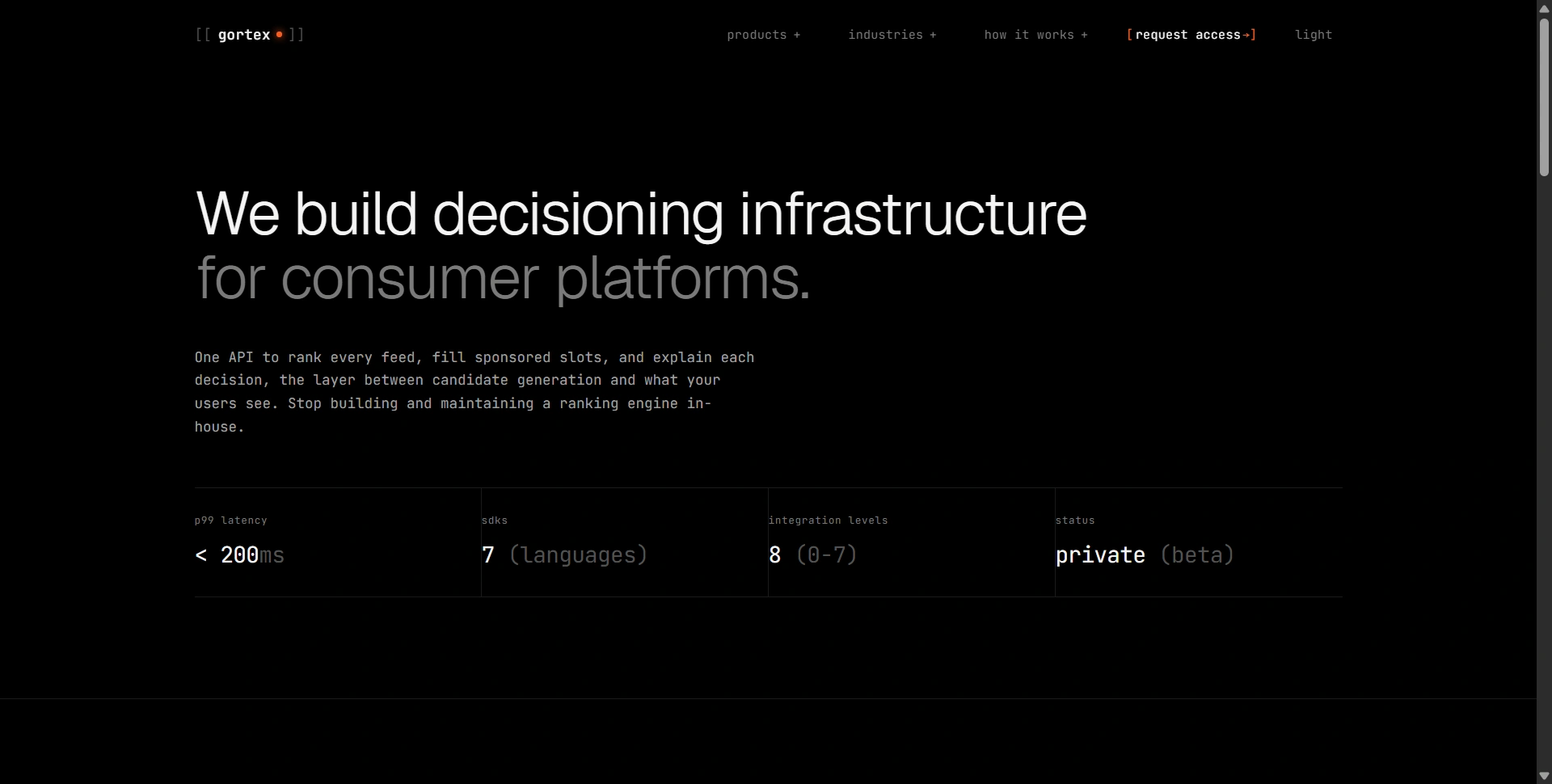
Best for: Marketplaces that already retrieve listings and want ranking plus sponsored placements in one decision.
Gortex sits between candidate generation and the listings a buyer sees. Your app supplies a recipient, context, and candidate items to its decision endpoint. The response contains ordered items, sponsored placements, and identifiers for tracing decisions.
Its marketplace ranking page describes balancing buyer relevance, take-rate, and supply fairness. That's a useful focus for a two-sided business where maximizing immediate clicks can concentrate exposure among established sellers.
Key features:
- Organic ranking and sponsored slots in one response.
- Decision and trace IDs for investigating placements.
- Seven typed SDKs generated from an OpenAPI specification.
Marketplace use cases:
- Rank available professionals within a buyer's area after your marketplace retrieves the eligible candidates.
- Resolve sponsored placements alongside the organic order, using the candidate and availability data your team supplies.
Pros:
- Explicitly addresses marketplace economics and placement traceability.
- Keeping your existing retrieval system can make an initial experiment easier to scope.
Cons:
- Currently available through invitation-only private beta.
- Public pages don't establish a standard price or independently verified conversion uplift.
- Access, support, data requirements, and production commitments need confirmation before launch.
Pricing: Request beta access and commercial terms. Its recommendation API page claims a sub-200ms p99 budget; validate that with your candidate sizes and network conditions.
Our judgment: Our first shortlist option for teams specifically evaluating combined ranking and monetization. Run a limited pilot and verify seller-exposure outcomes before expanding.
2. Recombee
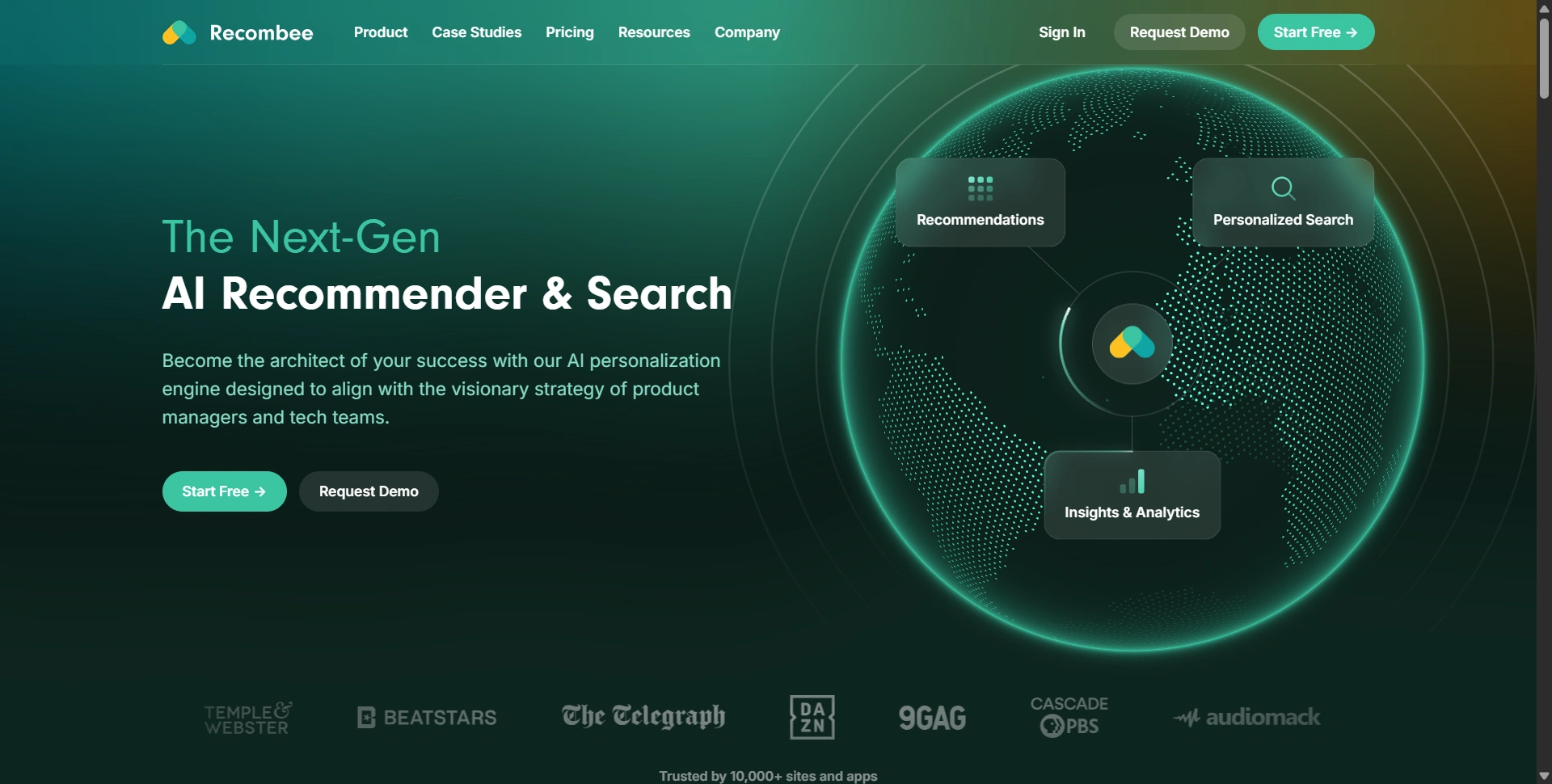
Best for: Startups wanting managed personalization without maintaining recommendation models themselves.
Recombee provides recommendations based on user interactions and catalog information. Its recommendation endpoints include items-to-user and items-to-item requests, covering personalized homepages and related-listing sections.
The practical work is connecting your catalog, sending meaningful events, and rendering results. For a resale marketplace, that means promptly removing sold listings and keeping attributes such as category, condition, and price consistent.
Clean descriptions help establish what a listing actually offers. If sellers need drafting support, our AI writing tools comparison covers options for preparing copy. Have sellers verify the details before publishing; invented specifications will undermine both buyer trust and any recommendations based on those attributes.
Key features:
- User-based and item-based recommendation endpoints.
- Recommendation IDs for connecting subsequent interactions with recommendations.
- API integration, no-code widgets, and widget SDKs.
Marketplace use cases:
- Show returning buyers listings related to their previous browsing.
- Add relevant alternatives on individual listing pages.
- Use bestseller or trending fallbacks for completely new users and items without interaction or property data, as described in its getting-started documentation, while richer signals accumulate.
Pros:
- The managed approach suits a small engineering team.
- Separate recommendation endpoints make it easier to launch one useful placement before personalizing the whole product.
Cons:
- Accidental page views, duplicate purchase events, or stale catalog records can weaken results.
- Budgeting involves more than API requests, because active users and catalog size have their own allowances.
Pricing: Recombee's pricing page lists a 30-day trial, a free plan, and Standard starting at $99/month. The free tier lists fewer than 100,000 monthly interactions and recommendation requests, plus fewer than 20,000 active users and catalog items. Check every allowance against your expected workload.
Our judgment: A practical general-purpose option when you want to ship behavioral recommendations with a manageable integration and a free starting tier.
3. Amazon Personalize
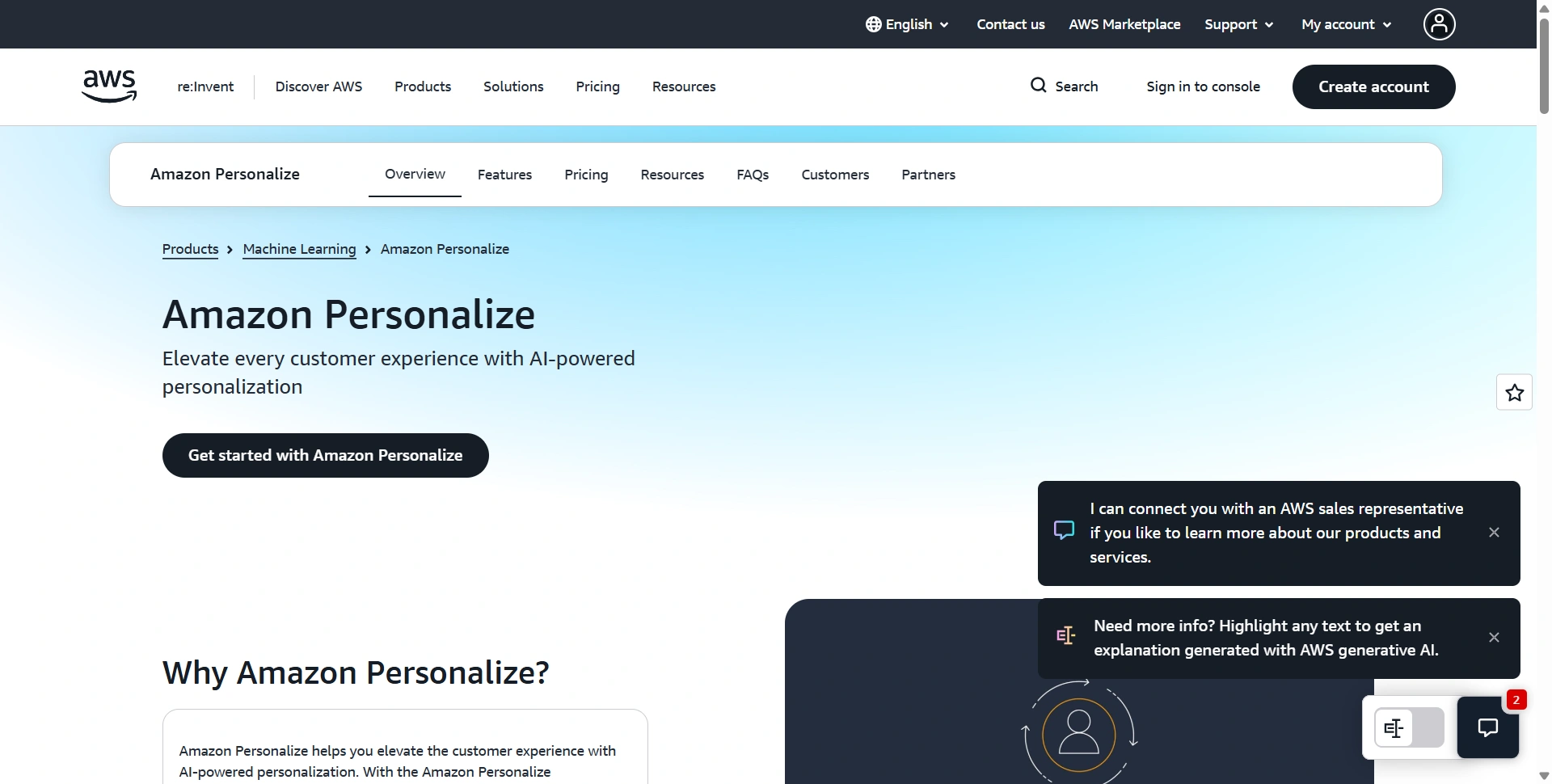
Best for: AWS-based startups with reliable interaction data and engineers who can own the recommendation pipeline.
Amazon Personalize offers managed machine learning for recommendations and personalized ranking. Its supported data includes interaction events, item attributes, and user metadata, with capabilities depending on the recipe or use case.
The important startup constraint is data readiness. AWS specifies a minimum of 1,000 item interactions and 25 unique users with at least two interactions each. For quality recommendations, it recommends at least 50,000 interactions from 1,000 users with two or more interactions each.
Key features:
- Custom recommendation and personalized-ranking recipes.
- Real-time and batch recommendation workflows.
- Use-case-specific ecommerce recommenders.
Marketplace use cases:
- Generate homepage recommendations from browsing and purchase history for a marketplace with established traffic.
- Use batch recommendations for scheduled campaigns, choosing the workflow around your placement and freshness requirements.
Pros:
- Supports building a broader recommendation system around an existing AWS stack.
- Published data requirements help determine whether your startup is ready to train.
Cons:
- Your team still manages schemas, imports, events, recipe choices, and application integration.
- Meeting the minimum data threshold doesn't prove recommendations will beat a well-designed popularity baseline.
Pricing: AWS lists v2 recipe rates of $0.05/GB uploaded, $0.002 per 1,000 training interactions, and $0.15 per 1,000 inference requests. Other recipes use different billing. Check minimum provisioned throughput: AWS's examples include charges during quiet hours, so multiplying actual calls by the headline rate can underestimate costs.
Our judgment: Strong for a technically prepared AWS team. We'd postpone it when clean event collection and available engineering time are still unresolved.
4. Algolia

Best for: Marketplaces already using Algolia search and adding product discovery placements.
Algolia Recommend trains models using product data and user interactions. It combines collaborative filtering with content-based approaches, which use attributes such as titles and descriptions to find similar records.
That makes it a natural shortlist candidate when your listings already live in Algolia and your team understands its indexing workflow. Existing integration work can make an additional discovery placement simpler to evaluate.
Key features:
- Related Products and Frequently Bought Together models.
- Looking Similar and trending recommendation options.
- Recommendation UI libraries for JavaScript and React.
Marketplace use cases:
- Add alternatives beneath product listings so shoppers can keep browsing when the original item doesn't fit.
- Suggest complementary products for replenishable goods to help buyers assemble a basket.
Pros:
- The search connection gives teams a familiar catalog foundation.
- Ready-made recommendation components support common frontend stacks.
Cons:
- Good recommendations depend on synchronized records and meaningful events.
- Frequently Bought Together needs careful testing: Algolia's model guidance explains that the relaxed variant can infer pairings, while the strict variant uses historical co-conversions.
- For unique secondhand listings, alternatives may be more useful than repeatable basket combinations.
Pricing: Algolia's pricing table lists plan-dependent Recommend allowances, including 10,000 monthly requests followed by $0.60 per additional 1,000 on its listed Grow plans. Include search and record costs when estimating your full bill.
Our judgment: A sensible extension for an Algolia-based marketplace. Compare the incremental setup and total cost with adopting a separate recommendation service.
How should you choose and test an API?
Start with one placement: homepage recommendations, related listings, or a ranked browse feed. Write down the eligible inventory, required response time, fallback, and monthly budget before integrating.
Then compare the API with your current experience using a randomized experiment. Track completed purchases or bookings per session, contribution margin, cancellations, and seller exposure. Measure new buyers separately from returning buyers so sparse-history performance doesn't disappear inside an average.
For a simple cost model, 100,000 sessions with three recommendation calls each produce 300,000 calls before retries. Add ingestion, training, minimum capacity, and engineering costs. Keep a fallback when the service times out.
Include sold-out items, first-time visitors, and newly listed sellers in your pilot checks. Decide how much repeated exposure one seller should receive and how quickly a withdrawn listing must disappear. Record the items actually shown, rather than only the API response, so your analysis reflects what buyers saw. These checks help distinguish a ranking problem from missing inventory updates or a frontend that never displayed the recommendations.
We'd begin with Gortex when ranking and sponsored listings are the specific problem, Recombee for broader managed personalization, Amazon Personalize for an AWS pipeline, and Algolia for discovery alongside existing search. Choose one surface, establish a baseline, and make the pilot earn a wider rollout.